
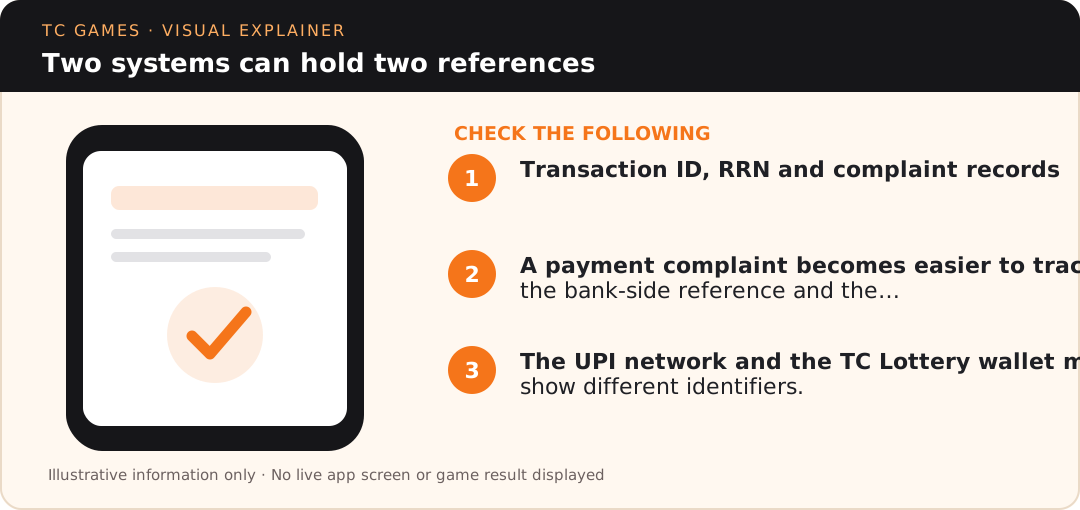
Transaction ID, RRN and complaint records
TC Lottery UPI Transaction ID & RRN: What to Save for a Payment Complaint
A payment complaint becomes easier to trace when the bank-side reference and the TC Lottery wallet-side order are kept separate. Save the transaction reference, amount and time first; never send another payment just to create “fresh proof.”
Last checked:
In brief
Which UPI reference belongs in a complaint
For a disputed TC Lottery-related UPI transaction, identify the bank reference number (often RRN or UTR), the amount, date, payee and payment status. The app reference and bank reference may differ. Share only masked records through verified channels; do not disclose authentication credentials.
Payment Evidence
Start with the bank-side reference
After a UPI payment, open the transaction details in the UPI or banking app you used. Save the transaction number or RRN, amount, date, time and payee information exactly as displayed. NPCI’s complaint form uses a 12-digit transaction number or RRN for supported complaint workflows, showing why this reference is important for tracing a payment.
Do not rely only on a cropped success screenshot. A screenshot can be useful, but the underlying transaction detail is stronger because it includes the reference and status that the payment system recognizes.
Payment Evidence
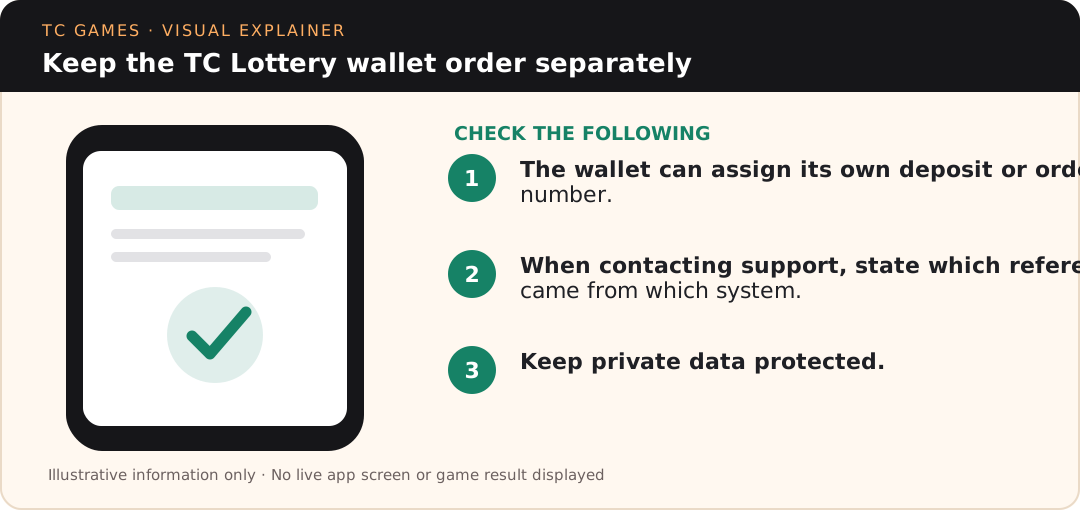
Keep the TC Lottery wallet order separately
The wallet can assign its own deposit or order number. That value is not a replacement for the UPI reference. Save both when available: one links the bank-side transfer, and the other links the wallet-side request. If the live wallet shows pending, failed or completed, record the wording and the time you checked it.
When contacting support, state which reference came from which system. Writing “transaction ID” without saying whether it is the UPI RRN or wallet order can create unnecessary back-and-forth.
Examples to compare
UTR, RRN and wallet order: use the right identifier
| What you see | Practical next check |
|---|---|
| Payment app shows one order ID | Find the bank UTR/RRN separately; different systems use different labels. |
| Support requests the transaction details | Send date, amount and masked reference through a verified channel only. |
| Complaint status has not changed | Keep one case history and cite the existing reference rather than filing duplicates blindly. |
Payment Evidence
Pending is different from unauthorized
An intentionally initiated deposit that is debited but not reflected in the wallet is a reconciliation problem. Use the UPI deducted but wallet pending checks to compare bank and wallet states before repeating the transaction.
A payment you did not authorize is a security and banking issue. NPCI’s complaint information says fraudulent, unidentified or unauthorized transactions should be raised with the customer’s respective bank for redressal. Do not wait for a gaming wallet conversation to replace the bank-side complaint process.
Payment Evidence
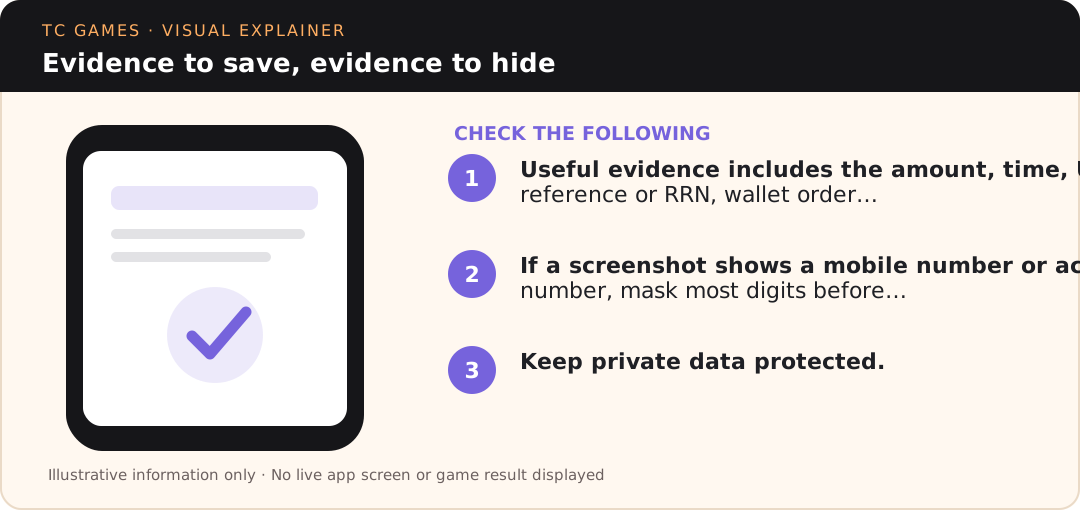
Evidence to save, evidence to hide
Useful evidence includes the amount, time, UPI reference or RRN, wallet order ID, status text and a masked account identifier. Hide the UPI PIN, OTP, full debit-card number, full bank-account number and any recovery credentials. Support does not need those secrets to identify a transaction.
If a screenshot shows a mobile number or account number, mask most digits before sharing it outside your own records. Keep the original privately if your bank requests it through its authenticated support process.
Payment Evidence
Do not create a second payment for proof
A common mistake is sending a small second amount because someone claims the first transaction cannot be located. That creates a new reference and can make the timeline more confusing. A traceable complaint should start from the original payment details.
If the original transaction shows failed and the bank balance was restored, a second deposit may be a separate decision. If the original remains pending or successful while the wallet disagrees, wait for the relevant resolution route instead of multiplying transactions.
Payment Evidence
Complaint record template
| Field | Where to find it | Share safely? |
|---|---|---|
| UPI transaction number / RRN | UPI or banking transaction details | Yes, through appropriate support. |
| Amount and timestamp | Bank or UPI app | Yes. |
| Wallet order ID | TC Lottery wallet/deposit history | Yes. |
| UPI PIN or OTP | Private credential | No. |
| Full card or bank credentials | Private financial data | No. |
Build a timeline
One clear transaction timeline is better than many screenshots
A strong payment record reads like a short timeline: the wallet order was created, the UPI payment was authorized, the bank assigned a reference, and the wallet later showed a particular status. Put those events in chronological order with timestamps. That makes it easier to see whether the disagreement is between a successful bank transfer and a pending wallet, or whether the bank itself still considers the payment pending.
When the status changes, keep the new state without deleting the earlier record. A pending transaction that later becomes failed or reversed tells a different story from one that remains successful at the bank while the wallet stays unchanged. The final complaint should describe the current state and mention the earlier state only when it helps explain the sequence.
If a bank gives a complaint reference number, preserve it separately from the UPI RRN. They are not interchangeable. The RRN identifies the transaction; the complaint reference identifies the support case. Keeping both prevents a later support conversation from losing the connection between the payment and the action already taken.
Reference checks
Sources and related TC Lottery checks
The TC Games payment checks overview keeps the main wallet and account routes together, while this article focuses only on transaction evidence and escalation records.
- NPCI: complaint registration and RRN requirements
- NPCI: UPI product and security information
- TCGames.co.in: deposit and withdrawal information
Banking definitions explain transaction references; the status of a specific transfer must be confirmed from the bank or payment application record.
Read the video text
Two systems can hold two references. Transaction ID, RRN and complaint records
Keep the TC Lottery wallet order separately. The wallet can assign its own deposit or order number.
Evidence to save, evidence to hide. Useful evidence includes the amount, time, UPI reference or RRN, wallet order…
Worked complaints: match one payment to one order
Find the bank reference in the correct place
A merchant order number, the reference displayed by a wallet and the UPI transaction reference may be different strings. When a payment is disputed, open the original payment application and locate the completed or pending transaction. Note the bank-issued UTR or RRN if available, alongside the amount, date, recipient and current payment status. Do not guess a missing digit from another receipt, and do not share full account numbers in public groups. If the banking app cannot locate the transfer, contact the verified bank or app support with the available records rather than inventing a reference.
When a wallet order and a banking transfer use different IDs, put them side by side rather than choosing whichever number is easiest to copy. Include amount, date, transaction status and the payee shown by the UPI app. A UPI reference allows the bank or payment provider to investigate the transfer; a wallet order identifies the corresponding platform request. Do not publish full account identifiers or share private PINs while reporting the mismatch.
One report, one timeline
Suppose a bank debit occurs at 14:03, the payment app marks it successful at 14:04 and the service wallet still reads pending at 14:07. Those times tell a story, but none individually proves when the wallet should settle. Keep the bank and service events in order and include any later status changes. Repeatedly opening new complaints with different descriptions makes tracking difficult; where a reference exists, follow up against it. A screenshot should show the relevant status and timestamp without exposing passwords, OTPs or unrelated private messages.
Know the difference between a refund and a withdrawal
A refund reverses or returns a payment, while a withdrawal is a separate action initiated through an account service. Their identifiers and expected handling processes may differ. Someone asking you to authorise a new UPI transfer to “receive” a refund is a serious warning sign. Read the payment screen before entering a PIN. If an unauthorised transfer occurs, use the verified bank or payment provider’s fraud/dispute path promptly, preserving the original bank reference and suspicious contact details. Do not rely on a chat participant who asks for another payment to speed up the process.
Specific questions
Questions readers ask about this issue
What should I do if payment app shows one order ID?
Find the bank UTR/RRN separately; different systems use different labels.
What should I do if support requests the transaction details?
Send date, amount and masked reference through a verified channel only.
What should I do if complaint status has not changed?
Keep one case history and cite the existing reference rather than filing duplicates blindly.
Are an order ID and UPI RRN always the same?
No. Payment apps, banks and platforms may assign separate identifiers to one transaction.
Should I send an unmasked bank statement to a Telegram helper?
No. Use independently verified support and share only the minimum masked information required.